
Conrad Ricamora Is Home at Last
As he prepares to play Zach in A Chorus Line, the Tony and Grammy-nominated Filipino-American performer returns to the land his father once left





Returning in reverse
He starts crying before the plane even lands—not when the cabin doors open, not when Manila air rushes in thick and familiar to everyone but him, but from above, while the mountains are still miniature and the sky looks pristine.
Sixty years ago, his father left the Philippines as a 10-year-old boy. Conrad Ricamora, now in his forties, descends toward the same land in reverse, watching the sky his father once saw as departure rather than return.

“He’s never been back,” Conrad tells me, and you can feel the weight in that sentence. To imagine his father leaving as a child and to be the one who returns—that is the full circle that undoes him.
This is the first time he has set foot in the Philippines—and for a man who grew up with Filipino blood but without a Filipino community, that distinction matters. Raised by his father after his mother left when he was a baby, moving through Air Force bases in the United States where theater barely existed and faces like his were scarce, Conrad grew up metabolizing a culture that did not reflect him back. “I always felt like I was trying hard to belong,” he says plainly.
There is a long history in American media of looking down on Asian men: diminishing, flattening, desexualizing, and rendering them ornamental at best. You absorb that messaging when you’re young. You don’t know you’re absorbing it. You just know you’re working very hard to justify your presence.
“I didn’t realize how exhausted I was. That’s 47 years of living in a country where I felt like I had to work so hard just to feel like I was allowed to exist.”
And then he gets here. He looks around. It isn’t that everyone looks exactly like him—that would be too easy—but there are echoes: bone structure, a way of inhabiting a room with courtesy, even a surname that doesn’t have to be explained.
The longer he stays, the more something loosens. “I can feel it leaving my body,” he says of the tension he’s carried for decades. The relief is physical. The belonging is cellular. The realization is almost cruel in its clarity: he did not know he was bracing until he no longer had to.

Identity in fragments
For someone experiencing what he considers a homecoming, the mythology he inherited was surprisingly sparse. His father cooked pancit, lumpia, adobo—cuisine as continuity—but stories were rare. Catholic school nuns who were “really mean.” A military career. Silence.
It wasn’t until Conrad began starring in Here Lies Love, the Broadway production centered on the Marcos era, that his father started offering fragments of memory.

He played Ninoy Aquino, a role carrying both historical gravity and emotional expectation. Landing at an airport bearing Ninoy’s name—passing the bust of the man he once embodied nightly and earned Tony and Grammy nominations for—felt less like a coincidence and more like an inheritance demanding acknowledgment.
Conrad later learned that his great-uncle, Ruben Fruto, had worked in Cory Aquino’s administration, a fact his father had never mentioned. Identity, for the actor, has arrived in installments.

Watching Lea Salonga perform in Les Misérables while he’s in Manila crystallizes something further. Everyone talks about her voice, he says, but what strikes him is her range—the emotional bandwidth that could have been utilized more in North America if not for what he bluntly calls “baked-in racism.”
There, she was funneled into a narrow lane of Asian-coded roles. Here, she expands.
“It made me feel like I’m allowed to be more than what I thought I could be,” he says, and the word allowed surfaces again, insistently. Allowed to explore beyond The King and I, where he made his Broadway debut. Allowed to endeavor beyond Miss Saigon, which has served as a golden ticket to Lea and many other Filipino thespians. Allowed to access full humanity without every creative choice being reduced to Asian-ness as a qualifier.

Walking through the halls of Art Fair Philippines, surrounded by visual work that feels “vibrant and alive,” he senses not novelty but an ecosystem. “There’s a scene here. There is a community here. I could live here.” Pride, he admits, is new in this register—not hashtag pride, but expansive pride.
Growing up, that sense of lineage was not obvious. He saw Lou Diamond Phillips in Young Guns without realizing Lou was Filipino. “I thought he was Mexican,” he says with a register somewhere between amused and telling.
The awareness came later, once he entered rehearsal rooms and found other Filipinos, once he could triangulate himself within a broader narrative. Before that, he simply felt like the odd person out—not part of a continuum, but an anomaly.

It wasn’t until How to Get Away with Murder premiered in 2014 and Filipino audiences began flooding his messages with “Pinoy pride” that he felt the digital outline of a community forming around him. It felt, he says, like people lifting each other up.
The stage as home
He is in Manila to play Zach in Theatre Group Asia’s run of A Chorus Line—the director who demands vulnerability from dancers auditioning for survival in an industry that chews through talent without sentimentality. Zach can read as harsh or cutthroat, but Conrad reads him as honest.
“I wouldn’t have been able to play Zach before,” he says. Only in the last few years has he realized he is often the most experienced actor in the room. He has lived open calls, $75-a-week jobs, and sideways moves disguised as progress. He understands the brutality because he survived it.
READ ALSO: TGA Announces Philippine and International Musicals for 2026-27 Season
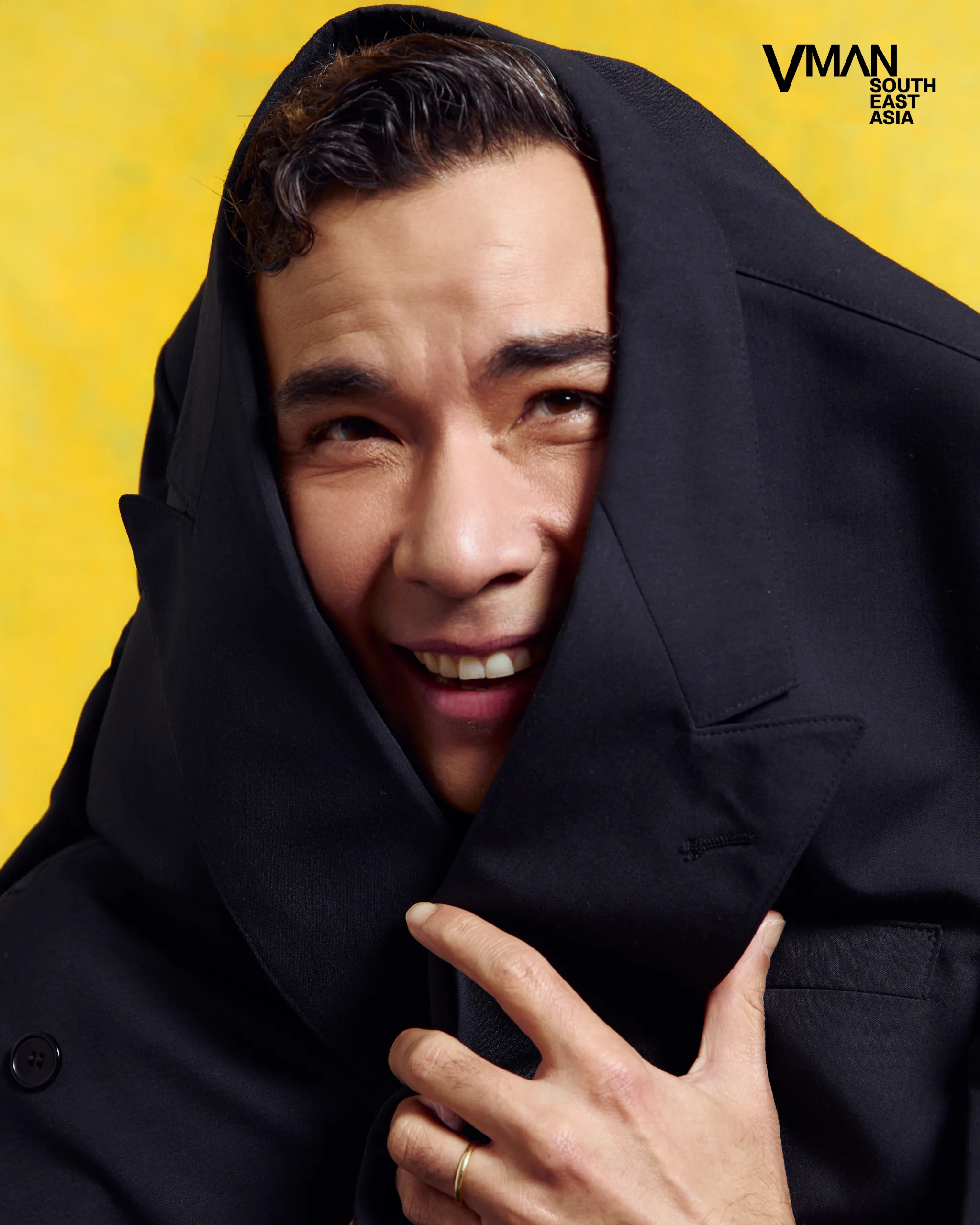
“If Zach doesn’t say it, someone else will at the next audition,” he says. “It’s better that it comes from him—in a space where he can guide them through it.” Age, in this instance, is authority earned, not liability.
Despite a career spanning television, film, and Broadway—from How to Get Away with Murder to Fire Island to Oh, Mary!—theater remains his anchor because of its immediacy. “We breathe the same air as the audience,” he says. “Monday’s show won’t be the same as Tuesday’s.” Film lingers in distribution; theater combusts in real time.

Performing A Chorus Line for a Filipino audience adds another dimension, but it does not intimidate him. Early in his career, he made peace with failure as inevitability. If you stay long enough, you will bomb. The point is not to avoid it but to remain open to experience—good or bad—and focus on the character in front of you. “At the end of the day, we’re all human,” he says. “That’s universal.”
That universality does not erase structural inequity, which is why he launched The Right to Be There, a fundraising initiative supporting Asian American male actors navigating an industry that historically minimizes them. He is candid about the pattern: incremental progress that does not always translate to sustained opportunity as it might for white counterparts.
“It takes a toll,” he says. “It makes you question why you’re doing this when your presence feels minimized.” His response is deliberate: if those in positions of relative visibility contribute what they can, the cumulative effect becomes momentum rather than stall.

Conrad’s advice to younger Filipino creatives, particularly in the diaspora, is deceptively simple: stay focused on the work. Open calls. Gradual progression. The glamour narrative is fiction; the craft is the constant.
And now, newly returned, there is a second directive layered onto that: come home. “I want to keep coming back to Manila for the rest of my life,” he says, without hedging. Not as a novelty. Not as heritage tourism. But as practice and participation.
Telling stories here, for a Filipino audience, feels different because he does not feel diminished. “You get the full sense of your humanity,” he says—and there it is again, that insistence on fullness.

Before he leaves, there will be a beach trip—three days off in March, somewhere beautiful whose name temporarily escapes him but whose promise does not. What he hopes to take back to the United States is less scenic and more internal: a recalibrated nervous system.
“I didn’t know this trip would be healing,” he says. Growing up in Western media landscapes where no one looks like you does something quiet and corrosive. You internalize absence. You construct armor. Anxiety and anger sediment over time. “The longer I’m here,” he says, “I feel that leaving me.”

What he wants to carry back is simpler than reinvention and more radical than pride: security. Belonging. The understanding that there is nothing inherently wrong with him—not in this skin, not in this body—and that existence need not be earned through overperformance.
For a man who spent decades proving he had the right to be in the room, coming home for the first time has given Conrad Ricamora something subtler and far more enduring: the right to simply be.
Photography Belg Belgica
Art direction Summer Untalan
FashionFashionThe art and industry of designing, producing, and styling clothing, footwear, accessories, and beauty trends. It reflects cultural influences, personal expression, and evolving styles across seasons and markets.Go to Fashion Glossary Corven Uy
Editor Dayne Aduna
Grooming Myckee Arcano, assisted by Jam Jacobe
Photography assistants Hallvard Cano and Xavier Mallari
Special thanks Danica Valdes-Lloren of Visions & Expressions
Frequently Asked Questions
Conrad Ricamora is a Filipino-American actor known for How to Get Away with Murder, Fire Island, and Broadway productions including Here Lies Love and Oh, Mary! His father left the Philippines as a child and never returned, making Conrad’s recent visit — his first — a personal reckoning with heritage, diaspora, and a cultural identity he grew up without a community to reflect it back.
Ricamora is playing Zach in Theatre Group Asia’s Manila production of A Chorus Line — the demanding director figure who pushes auditioning dancers toward radical vulnerability. He describes the role as one he could not have played earlier in his career, drawing on decades of experience navigating an industry that historically minimizes Asian American male actors.
Playing Ninoy Aquino in the Broadway production prompted Ricamora’s father to share fragments of memory he had previously kept private, including the revelation that a great-uncle had served in Cory Aquino’s administration. Arriving in Manila and passing through an airport bearing Ninoy’s name added a further layer of personal and historical convergence to a role that had already reshaped his sense of inheritance.
The Right to Be There is a fundraising initiative Ricamora established to support Asian American male actors working in an industry that has historically minimized their presence and opportunity. He describes a pattern of incremental progress that does not always translate to sustained opportunity — a structural inequity he believes those with relative visibility have a responsibility to address.
For Ricamora, arriving in the Philippines for the first time offered something he had not been able to name: the physical release of decades of tension built from growing up in Western media landscapes where no one looked like him. He describes the experience as cellular — a belonging that did not require justification — and frames it as a recalibration rather than a discovery, finding not a new identity but confirmation of one that was already his.

Recommended Video